Fender History
The Fender Broadcaster, Nocaster, and Telecaster (1950-1953)
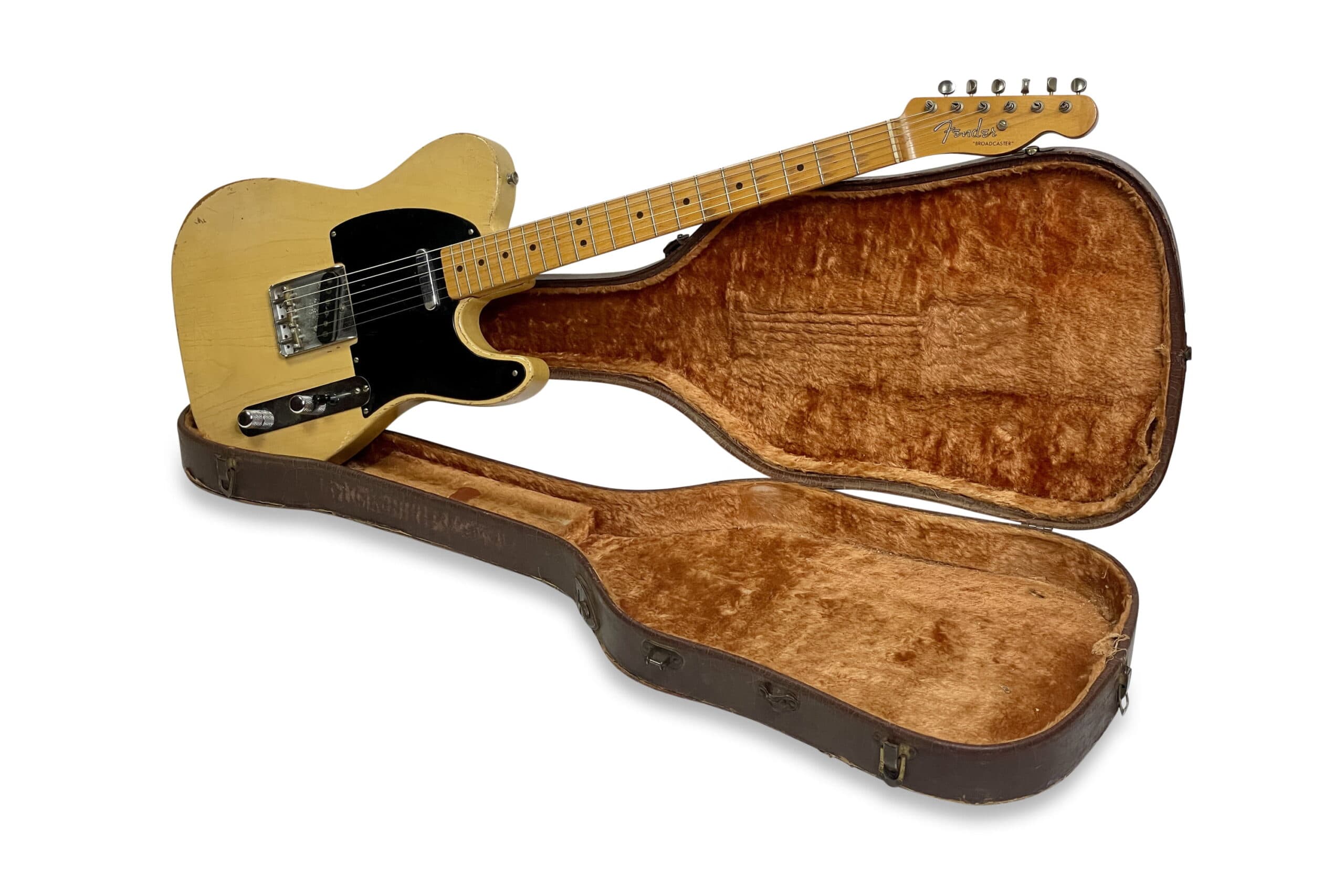
The story of the Broadcaster, Nocaster, and Telecaster is not simply a name-change story. It is the story of how one of the first mass-successful solid-body electric guitars became a durable industrial design platform that shaped recording practice, stage reliability, and the sound of modern popular music.
Before 1950: Why Fender's Approach Was Different
By the late 1940s, many electric guitars still reflected acoustic-era construction logic: carved tops, glued neck joints, and relatively delicate assemblies. Leo Fender was not trying to refine that tradition. He aimed to produce instruments that were repeatable, serviceable, and practical for working musicians who played loud dance halls and radio jobs multiple nights per week.
That mindset had major consequences. A bolt-on neck allowed fast replacement and easier setup work. A slab-style body simplified production and reduced failure points. Electronics were laid out for consistency and maintenance rather than ornate presentation. The result was less "luthier romance" and more field reliability, exactly what professional players needed in an era of heavy touring and evolving amplification.
1950: The Broadcaster Era Begins
In 1950 Fender introduced what became known as the Broadcaster, building on the earlier single-pickup Esquire concept but expanding into a two-pickup format that offered more range for bandstand use. In practical terms, players got attack and cut from the bridge position while still having a contrasting neck voice for rhythm and fuller lines.
Early Broadcasters established several design cues that remained foundational: string-through body construction, bridge plate geometry tied closely to tonal identity, and controls placed for immediate access during performance. Even when later wiring conventions changed, the core architecture remained surprisingly stable.
Historically, this matters because the Broadcaster demonstrated that an industrially produced electric guitar could still feel musically expressive while being easier to manufacture, repair, and standardize.
1951: Trademark Conflict and the Nocaster Window
The well-known trademark conflict with Gretsch over the "Broadcaster" name forced Fender to remove model text from headstock decals. For a transition period, instruments left the factory with the Fender logo but no model name, creating what collectors later labeled the "Nocaster" period.
The Nocaster interval is often misunderstood as a separate model. In reality, it was a production and branding transition while Fender kept building fundamentally the same design. That continuity is important: the company did not retreat from the platform. It continued to refine a concept that was already proving successful with working players.
For historians and collectors, Nocaster examples document a rare moment where legal pressure, factory pragmatism, and product momentum are visible on the instrument itself.
1951-1953: Telecaster and Platform Maturity
By later 1951, Fender adopted the Telecaster name, and by 1952-1953 the model's identity had stabilized in the market. This period, especially the "blackguard" years, is central because the guitar was no longer an experiment. It was now a proven production instrument with a clear reputation for reliability, articulation, and mix-friendly presence.
Engineers and musicians valued it for reasons that remain relevant: strong note definition, controlled low-end behavior, and transient clarity that survives dense arrangements. In country, early rock and roll, western swing, rhythm and blues, and later roots-driven styles, the format translated into recordings with remarkable immediacy.
The broader significance is that Fender's production thinking became a new industry norm. Modular neck joints, repeatable hardware schemes, and service-oriented electronics became central to electric guitar manufacturing well beyond Fender.
Technical Characteristics That Defined the Era
While exact specifications varied across months and batches, early Broadcaster/Nocaster/Telecaster instruments are broadly associated with an ash-body, one-piece maple-neck identity, paired with bridge and pickup systems that emphasize attack and harmonic detail. Hardware and wiring choices from this era can materially affect both tone and collectible value.
From a preservation standpoint, originality is often concentrated in less obvious places: solder integrity, bridge plate characteristics, tuner period-correctness, finish behavior, and neck/body date relationships. Replaced parts do not always eliminate significance, but they can alter historical integrity and valuation.
Why 1950-1953 Tele-Family Instruments Matter to Families Today
Families inheriting early Fender instruments often focus first on a simple question: "What is it worth?" That is understandable, but in this category value is tied directly to identification quality and provenance. The difference between a modified player-grade instrument and a largely original, well-documented example can be substantial.
Beyond price, these guitars represent a turning point in American manufacturing and music culture. They are artifacts of a design philosophy that prioritized function, maintainability, and consistency, and they influenced how electric instruments are still built and used decades later.
If a family possesses one, careful documentation before any irreversible work is essential: clear photos, serial and date details, hardware inventory, and whatever ownership story is available. Context, not just condition, often carries long-term historical weight.